
What Nobody Tells You About Planning a Live Event in a Connected World
Planning a live event used to mean booking a venue, sorting the catering, and hoping the sound system held up on the day. Today, the checklist looks quite different. Because your audience is no longer just the people walking through the front door.
They are also the ones who could not make it. The ones in different cities. The ones with young children at home. The ones who registered with full intention but had something come up at the last minute. And increasingly, events that do not account for that audience are leaving a significant chunk of their potential impact completely on the table.
Going live is not optional anymore. For most events worth attending, it is simply expected.
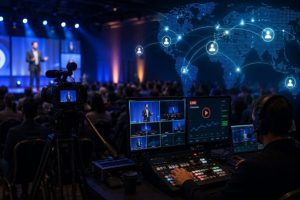
The Audience Has Fundamentally Changed
The shift in how people engage with events started slowly and then became impossible to ignore. Audiences now expect access. They expect that if something valuable is happening somewhere, there will be a way to participate even without being physically present. The organizations and planners who recognized that reality early have a genuine and growing advantage over those who did not.
But expanding your audience online is not just a matter of pressing a button and pointing a phone at a stage. The quality of the remote experience shapes how people perceive your event, your organization, and everything you stand for. A blurry, buffering stream with muffled audio communicates something. A clean, professional broadcast communicates something entirely different.
Going Live Is Not as Simple as It Sounds
Here is what most people planning their first live broadcast discover fairly quickly. The technical side has a real learning curve. Internet bandwidth. Camera placement. Audio mixing. Encoding settings. Backup connection plans. Each of these is its own variable, and any one of them can completely derail a broadcast at the worst possible moment.
For events where something genuinely important is being communicated to a wide audience, that is not a risk worth taking. Live event streaming done properly requires planning, dedicated equipment, and real expertise that most organizations simply do not have sitting around waiting to be used.
Why Technical Support Is Non-Negotiable
The live component of any event is the one that cannot be redone. A presentation can be revised and improved. A speech can be rehearsed and delivered again at another time. But the moment a keynote goes out to an online audience of hundreds or thousands, it happens once. If the stream drops, the audio cuts, or the wrong input gets fed to the broadcast at a critical moment, there is no recovering that experience for the people watching remotely.
This is precisely why access to event livestreaming services with technical support makes such a meaningful difference. Having experienced professionals on the ground, actively monitoring the stream, adjusting audio levels, and solving small problems before they become visible to the remote audience is what separates a polished live event from a forgettable or even embarrassing one.
It is not an added luxury. It is simply what doing things properly looks like in the modern event space.
Giving Your Event the Reach It Deserves
Here is the honest truth about live events. The content is almost always worth more than the room it is presented in. A compelling speaker deserves an audience beyond the people who could fit into a venue on a weekday afternoon. A meaningful announcement deserves to reach every stakeholder, not only the ones who traveled in for the day.
Thinking about reach as a core part of your event strategy, not as a last-minute afterthought, changes how you plan, how you execute, and how much value you ultimately create from the whole investment.
The room is just the starting point. What happens beyond it is where the real opportunity lives.


Leave a Reply